
What Is Progressive Overload? The Ultimate Guide to Building Muscle

Introduction: Why You Stopped Seeing Results
You were consistent. You trained hard, ate well, and for the first few months, you saw amazing progress. You were getting stronger, your clothes fit better, and you felt great. Then, suddenly, it stopped. The scale isn’t moving, you’re lifting the same weights you were a month ago, and your motivation is fading.
If this sounds familiar, you’ve likely hit a plateau. This isn’t your fault; it’s a sign that your body has adapted to your routine. The solution isn’t necessarily to train harder, but to train smarter. The key to unlocking continuous, long-term results is a fundamental scientific principle: progressive overload.
1. What is Progressive Overload? The Science of Adaptation
At its core, progressive overload is the principle of continually and systematically increasing the demands placed on your body. This forces it to adapt and grow stronger. This process is perfectly described by a biological concept known as General Adaptation Syndrome (GAS). In simple terms:
Alarm: You introduce a new stress (a challenging workout). Your body goes into an “alarm” state, experiencing fatigue and microscopic muscle damage.
Resistance (Adaptation): Your body repairs itself, but it doesn’t just go back to baseline. It rebuilds the muscle fibers slightly stronger and thicker to better handle that same stress in the future.
Exhaustion (Overtraining): If the stress is too much or too frequent without enough recovery, you can enter a state of exhaustion or overtraining.
Progressive overload is the art of applying just enough stress to trigger the “Resistance” phase over and over, without tipping into “Exhaustion.”
2. The 5 Key Methods of Applying Progressive Overload
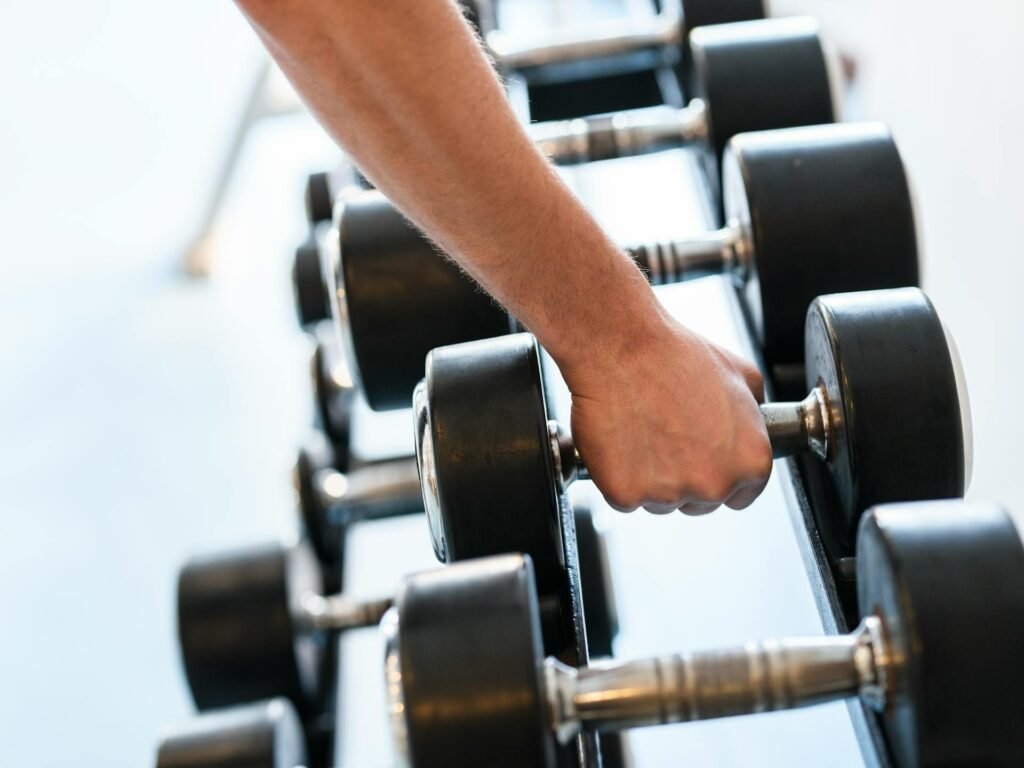
Here are the primary ways you can apply this principle to any workout, whether at the gym or at home.
2.1. Increase Resistance (Weight): The most straightforward method. If you bench-pressed 50 kg for 8 reps last week, this week you aim for 52.5 kg for 8 reps. This directly increases the mechanical tension on the muscle fibers, signaling them to grow stronger.
Best for: Building maximal strength and foundational muscle mass.
Practical Example (Dumbbell Bench Press):
Week 1: 15 kg dumbbells for 8 reps.
Week 2: 15 kg dumbbells for 9 reps.
Week 3: 15 kg dumbbells for 10 reps.
Week 4: 17.5 kg dumbbells for 8 reps (New cycle begins).
Pro-Tip: Never sacrifice form to lift a heavier weight. An injury is the fastest way to kill progress.
2.2. Increase Reps (Repetitions): Another excellent way to increase total workload (volume). If you performed 10 bodyweight squats last week, this week you aim for 12. Once you can comfortably hit a higher rep range (e.g., 15 reps), it might be time to increase the resistance (Method 2.1).
Best for: Muscle hypertrophy (growth) and muscular endurance.
Practical Example (Bodyweight Squats):
Week 1: 3 sets of 12 reps.
Week 2: 3 sets of 14 reps.
Week 3: 3 sets of 15 reps.
2.3. Increase Sets: Doing more sets of an exercise also increases total volume. If your routine called for 3 sets of 10 push-ups, next week you could aim for 4 sets of 10. This is a simple way to increase the overall challenge without changing weight or reps per set.
Best for: Breaking through plateaus and adding targeted volume for a specific muscle group.
Practical Example (Pull-ups):
Week 1 & 2: 3 sets to failure.
Week 3 & 4: 4 sets to failure.
Warning: More is not always better. Adding too many sets can quickly lead to overtraining and diminish your recovery capacity.
2.4. Decrease Rest Time: 4. Decrease Rest Time: Doing the same amount of work in less time increases the density of your workout. If you normally rest 90 seconds between sets, try cutting it to 75 seconds.
Best for: Metabolic conditioning and improving work capacity.
Practical Example (Circuit Training):
Week 1: Rest 90 seconds between circuit rounds.
Week 2: Rest 75 seconds between circuit rounds.
Pro-Tip: This method is very demanding. It’s best used for conditioning phases and is not ideal for pure strength-building, where full recovery between sets is crucial.
2.5. Improve Form & Tempo (Quality): This is an advanced but incredibly effective method. Instead of just lifting a weight from A to B, focus on the quality of the movement. For example, lower the weight for a slow, controlled 3-second negative (eccentric) phase on each rep. This increases the time under tension, a critical factor for muscle hypertrophy. This is a core concept we use in our Liftrix programs.
Best for: Increasing muscle fiber recruitment and improving the mind-muscle connection.
Practical Example (Dumbbell Curls): Instead of just lifting the weight, perform each rep with a “1-0-3-1” tempo: 1 second to lift (concentric), 0-second pause at the top, 3 seconds to lower (eccentric), 1-second pause at the bottom. The same 10 reps will feel significantly harder and more effective.
3. How to Track Your Progress (Don’t Train Blind)
You can’t manage what you don’t measure. The only way to ensure you are applying progressive overload is to track your workouts. Use a simple notebook or a notes app on your phone. For each workout, write down:
The date
The exercises you performed
The weight you used for each
The number of sets and reps you completed
Add Qualitative Notes: Don’t just write numbers. Add a note on how it felt. Many lifters use RPE (Rate of Perceived Exertion), a scale of 1-10. An “RPE 8” means you felt you had about 2 good reps left in the tank. This helps you know when you can push harder.
Before your next session, review your last performance. Your goal is simple: beat your last workout, even if it’s just by one extra rep.
4. Linking Progressive Overload to Your Goals
This principle is the foundation for almost any fitness goal.
For Muscle Gain: It is the single most important requirement. Without it, muscle growth is impossible.
For Fat Loss: While a calorie deficit is key (as discussed in our guide to fat loss mistakes), applying progressive overload ensures that you lose primarily fat, not precious muscle. Preserving muscle keeps your metabolism high.
5. How Often Should You Apply Progressive Overload?
You should aim to “beat your logbook” in some small way in every session, but this doesn’t always mean adding more weight.
Beginners: Can often add weight or reps every single week (this is called linear progression).
Intermediates/Advanced: Progress slows down. You might aim to add one rep this week, and the next week your goal might be to use the same weight and reps but with better form. Over a month, the trend should be upward. It’s also crucial to plan “deload” weeks with lighter training to allow for full recovery.
Remember that consistency is the most important part of making progressive overload work for you.
Conclusion: The Secret to Long-Term Success
Progressive overload is the antidote to the plateau. It’s the difference between “working out” and “training with a purpose.” It requires patience and consistency, but it is the only proven path to making continuous progress year after year.
The challenge is knowing which method to apply and when. This is where the science of program design comes in. Our programs at Liftrix Fitness are built with the principle of progressive overload at their core. We structure the progressions for you, taking the guesswork out of your training so you can focus on what matters: getting stronger and achieving your goals.
→ Let us handle the planning. Explore our programs.
